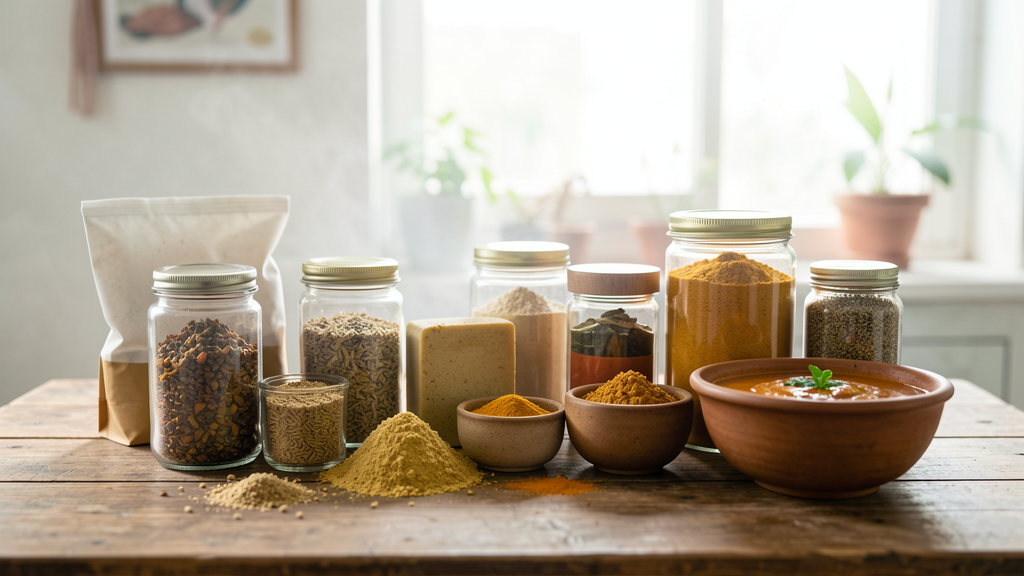
Editorial image illustrating Asafoetida Powder vs. Block: The Solubility Decision for Authentic Flavor
The smell hits you before you even see the jar—that pungent, sulfurous blast that signals a serious Indian kitchen. Yet, for such a powerful spice, Asafoetida (or Hing) is often misunderstood, mostly because it hits the market in two wildly different forms. One is a hard, rocky lump that looks like a crystallized stone, and the other is a fine, often yellowish powder that sits comfortably next to the turmeric.
I have watched countless home cooks frustrated by a dal that lacks depth or a stir-fry that tastes strangely dusty, despite a generous pinch of Hing. The issue usually is not the quantity of the spice but the format they chose. The chemical reality of Asafoetida dictates how it behaves, and ignoring its solubility profile is where flavor goes to die.
To get that umami-rich, onion-garlic mimicry we crave, you have to make a choice based on physics and chemistry, not just convenience.
The Solubility Case for the Raw Crystal
Let's talk about the block, also known as raw Hing or crystal Hing. This is the sap extracted from the rhizome of the Ferula assa-foetida plant, dried and hardened into a resinous mass. In its pure form, it is incredibly potent—so much so that handling a piece the size of a pea can fill a room with its aroma for hours.
The raw resin is lipophilic. It dissolves beautifully in fat but struggles significantly in water or aqueous mixtures. When you drop a tiny piece of this block into smoking hot ghee or oil, it sizzles, swells, and instantly infuses the fat with its volatile oils. This process is essential for dishes where the fat carries the flavor into the bulk of the ingredients, such as a traditional Dal Tadka or a Kadhi.
Using the block here is non-negotiable for authenticity. The high temperature required to bloom the resin burns off the harsh raw sulfur notes, leaving behind a savory, meaty background that mingles with the lentils. If you try to use water-based methods with the block, the resin will remain tacky and separate, creating pockets of intense, unpleasant bitterness.
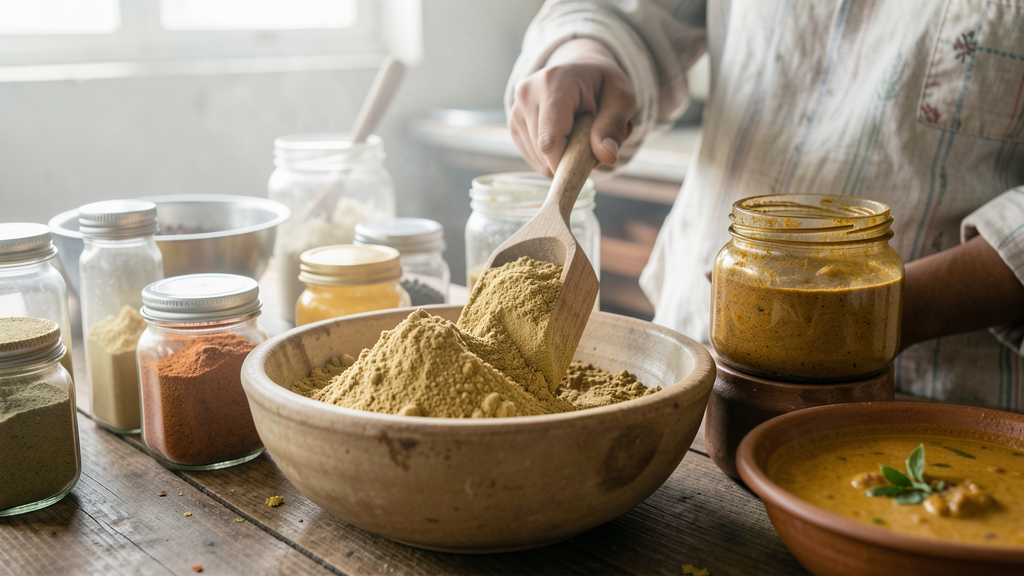
I always keep a small stone of raw Hing specifically for tempering. It requires a bit of effort—you often have to crush it with a mortar and pestle alongside a pinch of salt or rice flour to get a fine powder—but the payoff is a clean, unadulterated flavor profile that commercial powders rarely achieve.
Why Compounded Powder Wins in Dry Rubs
If the raw block is the purist's choice for hot oil, then compounded powder is the practical workhorse for the dry and quick-cooking side of the kitchen. Pure Asafoetida resin is too strong and too sticky to be used directly as a sprinkle. To make it usable in shakers, manufacturers grind the resin and mix it with a carrier flour, usually wheat flour or rice flour, and sometimes gum arabic. This is the "compounded" Hing you find in most aisles.
Because of the flour content, this powder disperses differently. It does not need to be dissolved in fat to release its flavor effectively, making it ideal for applications where oil is minimal or absent.
Consider a quick potato stir-fry or a dry spice rub for grilling. If you are marinating chicken for a Tikka, you likely want the Hing to integrate instantly with the yogurt, ginger, and garlic paste. The compounded powder mixes uniformly into these wet or semi-dry matrices without forming stubborn clumps of resin. I reach for the yellow powder when I am making 5 store-bought spice blends that are wasting your money replacements at home, specifically for dry blends like Pani Puri Masala or Chaat Masala, where the spice mix will be sprinkled over food as a finishing touch rather than cooked in a base.
However, you must account for the dilution. Since compounded Hing is often only 30% to 40% actual resin (sometimes less in cheaper brands), you have to use a larger volume to get the same impact you would get from a sliver of the raw block. This is where the "dusty" flavor I mentioned earlier creeps in. If you use too much powder trying to chase potency, you end up tasting the wheat filler rather than the spice.
Are You Cooking with 30% Hing or 100%?
The confusion often stems from recipes that simply say "add a pinch of Hing" without specifying the form. A pinch of compounded powder is a fraction of the strength of a pinch of raw resin. This discrepancy explains why your Why Does Your Garam Masala Taste Different Every Time?—inconsistency in ingredient strength creates unpredictability.
When you buy the block, you are buying 100% potency. The flavor is complex, with musky, earthy, and leek-like notes. When you buy the powder, you are buying a diluted product. The flour carriers mute the high notes and often flatten the overall aromatic curve.
For a dish that relies heavily on the Hing as a primary flavor driver, like a Tamil Vengaya Sambar (onion sambar) made without onions, the block is the only way to go. The water in the sambar cannot extract the flavor from a lump of resin efficiently, but if you temper the raw block in oil first and then pour that oil over the sambar, the transformation is immediate. The powder, added directly to the boiling liquid, often tastes muted and slightly grassy by comparison.
My verdict is strict here: if you are building a curry base from scratch, grating or crushing the raw block into your hot fat yields a superior, restaurant-grade result. If you are assembling a quick meal or a dry rub where the spice won't see a long simmer in oil, the compounded powder is safer and more consistent.
Keeping the Funk Fresh
Regardless of which form you prefer, Asafoetida is volatile, and losing its potency is a common kitchen tragedy. The essential oils are sensitive to light, air, and humidity. I learned this the hard way in 2024 when I left a jar of premium powder near the stove; within a month, it smelled like nothing more than dusty chalk.
For the raw block, store it in an airtight glass jar, ideally wrapped in a small piece of aluminum foil to protect it from light. It will last for years this way. I have a piece of Afghan Hing in my pantry that is three years old and still smells lethal.
For the compounded powder, the enemies are moisture and air. Once opened, transfer it to a tight-sealing container. Keep it in a dark cupboard, far away from the stove's heat. Even with optimal storage, I recommend replacing your powdered Hing every six months. The flour content can go rancid or simply lose the ability to hold the resin's aroma, leaving you with a bland filler that ruins your carefully measured spice ratios.
The Ritual of the Tadka
Deciding between powder and block is not just a technicality; it changes how you cook. Using the block forces you to slow down and prepare the tadka (tempering) with intention. You have to heat the oil, crush the spice, and watch it bloom. It is a sensory ritual that connects you to the texture of the ingredient.
Using the powder is a shortcut, and while valid, it lacks the theater and the depth of the resin.
My recommendation for 2026 is to challenge yourself to buy a small block of Hing. Keep the powder for your marinades and Chaats, but use the stone for your lentils. The difference in your next Dal Makahni will be palpable. You will notice a savory resonance that lingers on the palate long after the meal is over, something the powder simply cannot replicate.
Ultimately, the best Hing is the one that matches your cooking method's solubility. Match the resin to the fat, and the powder to the mix. Stop crossing the streams, and your curries will finally taste the way they were meant to.