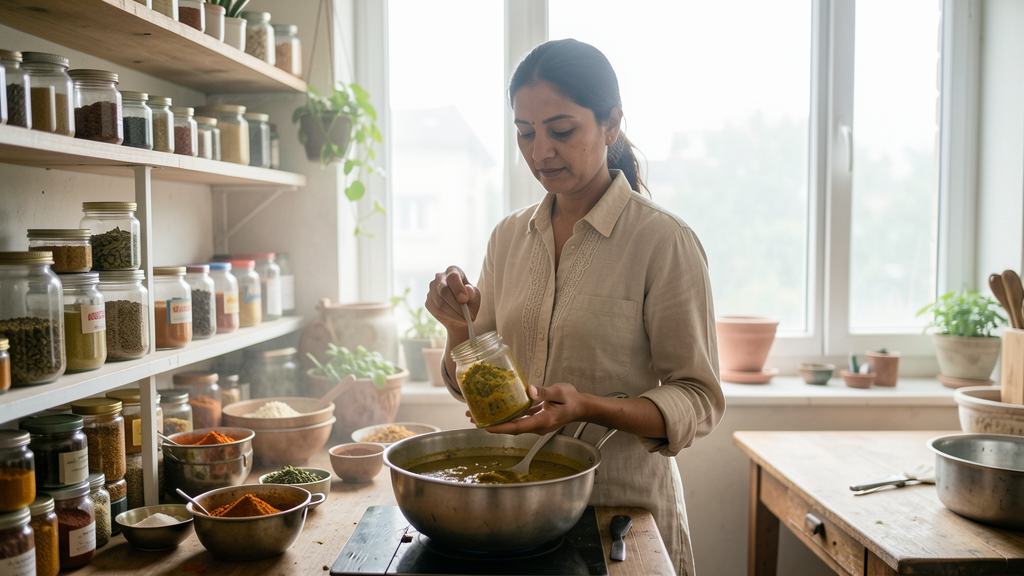
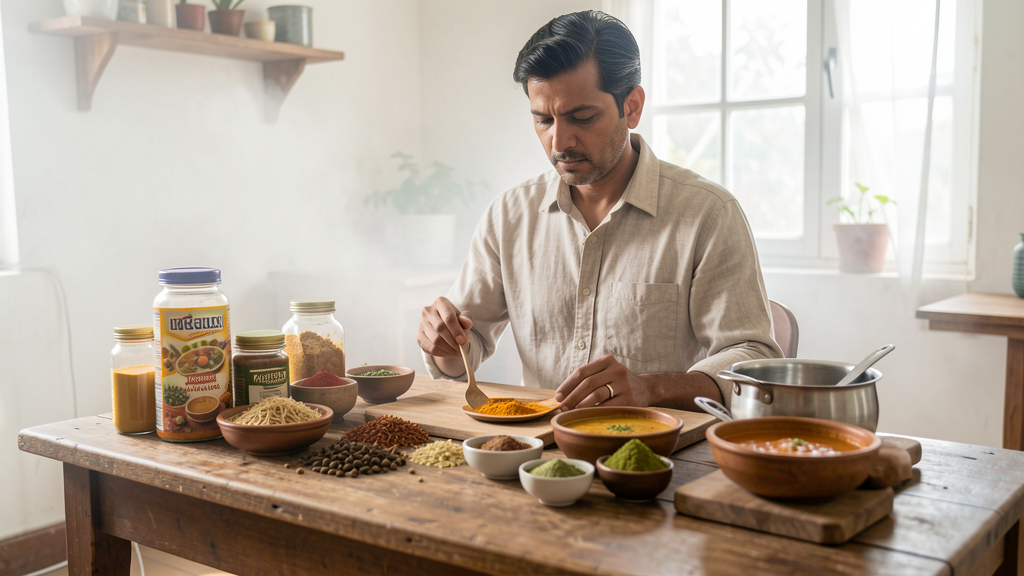
Editorial image illustrating The Chaos in Your Jar: Why Your Garam Masala Never Tastes the Same
You pulled off a brilliant butter chicken on a damp Tuesday in February. The spice blend was warm, aromatic, with just the right hint of clove to cut through the cream. Two weeks later, you followed the exact same recipe—same brand of tomatoes, same cut of chicken, same simmer time—but the result was flat, oddly sharp, and missing that deep, resonant hum you loved. You stare at the jar on the counter, wondering if the spices have gone rogue.
The culprit is almost certainly the physics inside your blender and the math on your countertop. When we make garam masala at home, we often treat "a pinch of this" and "a handful of that" as stable measurements. They are not. Unlike commercial blends that rely on industrial homogenization to ensure every gram tastes identical to the next, your homemade blend is subject to wild volatility based on density and particle size. If you want to replicate that Tuesday night magic, you have to stop treating your spice blend as a fixed entity and start treating it as a chemical reaction that changes every time you touch it.
The Density Trap: Volume versus Weight
The primary reason your blend fluctuates lies in the difference between volume and weight. Most home cooks measure their whole spices by the tablespoon or cup. This is a fatal flaw in consistency. A tablespoon of whole green cardamom pods weighs significantly less than a tablespoon of dense cumin seeds or heavy peppercorns. If you simply "eyeball" equal parts, you are drastically altering the ratio of flavor profiles every time you make a batch.
Consider the cinnamon bark. A thick Cassia bark chunk is mostly air and fiber compared to the dense, oily nut of a clove. If you use a volume-based recipe calling for "2 inches of cinnamon stick" and "1 teaspoon of cloves," but your cinnamon stick happens to be thinner than the one the recipe developer used, you have instantly lost the balance between the sweet, woody base and the piercing, medicinal top note. The spice trade is built on weight, yet our home kitchens are built on cups. This discrepancy is why that delicious batch from last month can never be perfectly recreated by memory alone.
I recommend moving to a digital scale immediately. It feels like extra work, but it solves 80% of the variance. If a recipe calls for 10 grams of coriander seeds, 10 grams is 10 grams, regardless of whether the seeds are plump or shriveled. If your spice storage is a mess, finding the right jars can add frustration to the process; reorganizing my spice drawer cut my dinner prep by 10 minutes, which gave me the mental bandwidth to actually weigh my ingredients rather than frantically scooping them.
The Grinding Method Changes the Chemistry
Once you have your ratios sorted, the machinery introduces a new variable. The method you use to pulverize your spices determines not just the texture, but the rate at which the essential oils oxidize and release flavor. A coarse grind in a mortar and pestle is a completely different ingredient from a fine powder produced by a high-speed electric grinder.
A coarse grind creates a "slow-release" flavor bomb. The larger particles have less surface area exposed to the hot oil in your pan. They will release their flavor slowly over a long simmer, providing a lingering background warmth. However, if you switch to an electric coffee grinder dedicated to spices, you create a micron-fine dust. This dust has immense surface area. The moment it hits the hot fat, it releases its entire payload of volatile oils almost instantly. If you cook this fine powder for the same duration as your coarse batch, the delicate top notes—the floral hints of the cardamom or the citrus zest of the mace—will burn off before the curry is even done. You are left with the bitter, charred remains of what could have been a great spice blend.
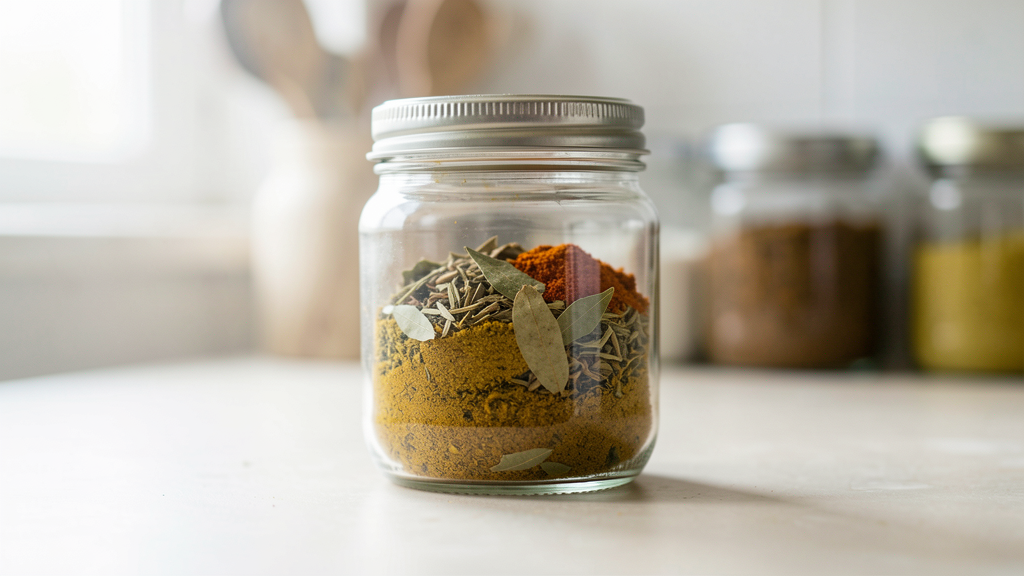
This inconsistency also affects mouthfeel. A fine powder dissolves into the sauce, becoming part of the liquid body of the curry. A coarse grind remains suspended, offering tiny bursts of intense heat or texture. If you are making a dish where texture is paramount, such as trying to keep potatoes firm in Aloo Gobi, a gritty spice blend can actually work against the structural integrity of the vegetables by creating abrasion that breaks down the edges during the stir-fry.
The Heat of the Moment: Toasting Variance
Even if you weigh your spices and grind them to the exact same micron size, the toasting step will introduce chaos. Roasting spices is not a binary state of "raw" or "toasted"; it is a spectrum. The difference between a perfectly toasted cumin seed and a burnt one is roughly fifteen seconds.
Spices have different moisture contents and oil densities. Coriander seeds, being larger and seedier, take longer to release their nutty aroma. Fennel seeds, loaded with volatile anethole, can turn from aromatic to acrid in the blink of an eye if the pan is too hot. When you throw a mix of spices into a skillet together, the smaller ones will toast faster than the larger ones. If you wait for the cinnamon to smell fragrant, your fennel is likely already overcooked.
This creates a cumulative error in flavor. One week, you might toast the blend for 45 seconds over medium heat, resulting in a sweet, nutty profile. The next week, distracted by a phone call, you might let them go for a minute and a half. The result is a darker, bitter blend that taints the entire pot. The only way to fix this is to toast spices in batches according to their density and size, adding the robust, hard spices like cloves and peppercorns to the pan first, and introducing the delicate seeds like fennel and mustard at the very end.
Storage and the Decay of Potency
You have navigated the ratios, the grind, and the toast. Now, you must confront time. The moment a spice is ground, its clock starts ticking. The essential oils that give garam masala its soul are volatile. They evaporate when exposed to air, heat, and light. This is why a fresh batch tastes "bright" and a three-month-old batch tastes "dusty."
To preserve the potency of your blend for at least six months, you must treat the finished powder like a perishable good. Do not store it in a clear glass jar on the counter next to your stove. The UV rays and the ambient heat from the burner will degrade the terpenes in the pepper and the eugenol in the cloves within weeks. Transfer your blend to an opaque, airtight container—stainless steel or ceramic is ideal—and store it in a cool, dark cupboard, far away from the oven and dishwasher.
Furthermore, do not grind a huge batch "to save time." It is tempting to make a year's supply, but the last quarter of that jar will be little more than flavored sawdust. I make small batches, roughly 100 grams at a time, enough to last a month or two. This ensures that the final spoonful tastes nearly as vibrant as the first. If you find that your curries are losing their punch halfway through a jar, it is not your cooking technique that has failed; it is the storage method.
Embracing the Variability
The ultimate solution to the inconsistency of homemade garam masala is not to fight for robotic uniformity, but to document the variables. Keep a small notebook in your kitchen drawer specifically for spice blends. Write down the date, the weight of the ingredients used, the duration of the grind, and the color of the final powder.
Instead of trying to remember "that good batch from last month," you will have data. You will be able to look back and see that the batch you loved on February 14th was ground coarsely and toasted for exactly two minutes, while the disappointing batch from March 2nd was fine powder toasted for three minutes. This notebook allows you to reverse-engineer your successes and replicate them with scientific precision. Accept that nature provides variance, but your notebook provides control. The curry will taste different every time, but with the right records, it can always taste delicious.