Editorial image illustrating Frozen Peas vs. Fresh Peas in Matar Pulao: The Texture Verdict
There is a specific kind of snobbery in Indian cooking that I have spent the last decade trying to dismantle. It is the unshakable belief that "fresh" is an immutable synonym for "superior." I see it constantly in the dry-vegetable-curries section of my site and in the messages flooding my inbox. Home cooks feel guilty reaching for the freezer bag, convinced that using anything other than peas shelled by their own hands that morning renders their Matar Pulao inauthentic or, worse, low quality.
I am here to tell you that this guilt is misplaced. If you are making Matar Pulao on a random Tuesday in 2026, and you are standing in a supermarket aisle deciding between a bag of frozen peas and a box of "fresh" peas that have been sitting on a refrigerated shelf for who knows how long, the frozen option is not just the convenient choice—it is the culinary superior. We are not talking about a negligible difference here; we are discussing the fundamental structural integrity of your final dish.
The core issue lies in water content and starch conversion. Most cooks fail to realize that a pea begins to die the moment it is plucked from the pod. The sugars that provide that characteristic sweet snap start converting to starch immediately. By the time that "fresh" pea reaches your kitchen, it is often a starchy, mealy shadow of its former self, prone to disintegrating into a mushy paste the moment it hits the boiling stock.
The Myth of the "Fresh" Supermarket Pea
Let us look at the logistics of the modern produce supply chain. Unless you live within a twenty-mile radius of a pea farm and are buying produce harvested that morning, the "fresh" peas available in most grocery stores are weeks old. They have been washed, sorted, packed, shipped, and stored. During this time, the pea undergoes rapid respiration, losing moisture and tightening its skin.
When you toss these aged fresh peas into a pot of rice, they cannot hydrate properly. Their skins have become tough and impermeable, while the interior has dried out. Instead of cooking into a plump, vibrant bead, they often wrinkle or burst unevenly. You end up with a pulao where the peas are either hard and chewy or have completely dissolved, leaving behind a starchy film that gums up the separate grains of basmati we work so hard to achieve.
Conversely, the peas in the frozen aisle are a different product entirely. They are harvested at peak ripeness—usually in the early morning when sugar content is highest—and transported to a processing facility within hours. There, they are blanched briefly in boiling water and flash-frozen. This process halts the enzyme activity that converts sugar to starch. That frozen pea is, chemically, closer to a pea just picked from the vine than the "fresh" one sitting in the produce section.
The Water Content Problem in Pilaf Cooking
Matar Pulao is a delicate balancing act. We are cooking rice in a measured amount of water, hoping that by the time the liquid evaporates or is absorbed, both the rice and the peas are perfectly cooked. This is where water content becomes the critical variable.
Fresh peas, especially if they are slightly past their prime, have unpredictable water retention. Some will absorb too much liquid from the pot, becoming bloated and forcing you to add more stock, which risks overcooking the rice into a khichdi-like consistency. Others will leach their internal moisture into the pot, diluting the spiced stock and making the rice soggy. This inconsistency makes achieving that perfect, dry-heat texture nearly impossible. I have had readers ask me why their pulao is always "wet," only to find out they are using huge, mature fresh peas that release too much moisture during the steam phase.
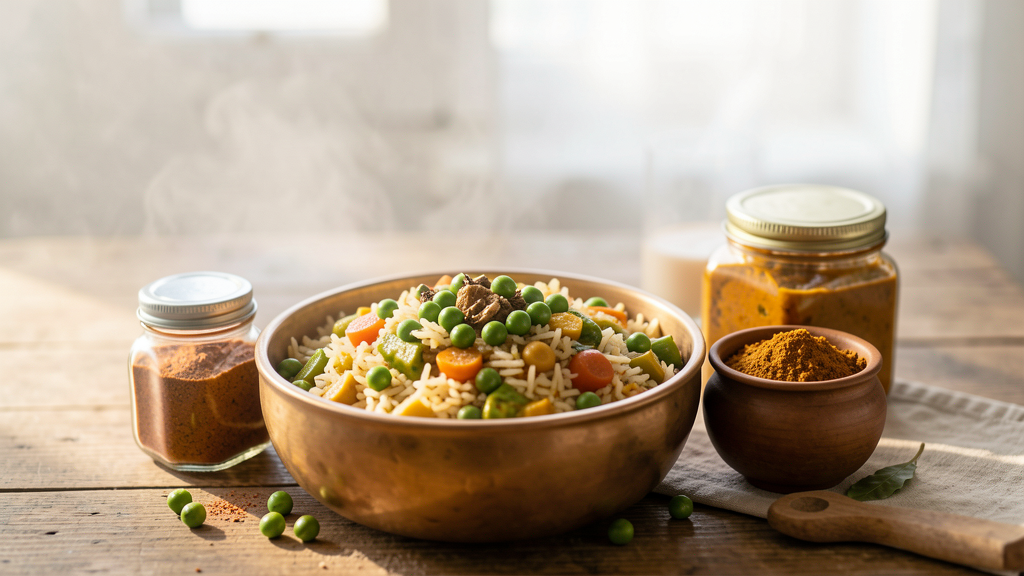
Frozen peas, however, offer a consistent baseline of hydration. Because they are blanched before freezing, they have already begun to break down slightly, which paradoxically helps them maintain structure better in a braising environment. They do not fight the rice for liquid. When you drop frozen peas into the pot, they thaw rapidly and cook evenly, releasing just enough moisture to flavor the rice without upsetting the hydration balance. This stability is the secret weapon of a weeknight curry writer. It allows you to follow a recipe with a 1:1.5 rice-to-water ratio with high confidence that the result will be fluffy, not sticky.
Texture Verification: The Burst Factor
I judge a Matar Pulao by the pop. When you bite down on a pea, there should be a brief resistance followed by a burst of sweetness. This textural interplay is what cuts through the richness of the spices and the basmati.
Out-of-season fresh peas often fail this test. They tend to be either woody or mushy. There is no pop, just a dull squish. This lack of texture makes the eating experience monotonous. You are chewing through soft rice and soft vegetables, which requires more jaw work and offers less satisfaction.
Frozen peas, provided they are not overcooked, retain a distinct "skin-grip" texture. They have a slight bite that contrasts beautifully with the tender grains of rice. This textural variance is crucial. Just as I advise regarding moisture management in How to Keep Potatoes Firm in Aloo Gobi, the goal in vegetable curries is often to preserve the individual identity of the vegetable. You do not want the pea to disappear; you want it to announce its presence. The cellular structure of a flash-frozen pea holds up better to the 15-minute simmer of a pulao than a fresh pea that has been degrading in a warehouse for two weeks.
The Weeknight Logistics of Shelling
We must also address the practical reality of the Massalaapp mandate: if it cannot be prepared and cleaned up in under 45 minutes, it does not belong on the weeknight table.
Shelling enough peas for a family-sized pulao is a meditative experience on a lazy Sunday, but it is a disaster on a Wednesday evening after work. Even if you buy pre-shelled fresh peas, you still have to pick through them, removing the damaged ones, and usually give them a wash. That is five to ten minutes of active work.
With frozen peas, the workflow is zero-friction. You open the bag, pour the amount you need into a strainer, run them under cold water for thirty seconds to remove any ice crystals, and they are ready. This efficiency is not about being "lazy"; it is about energy conservation. I would rather spend those saved ten minutes perfecting the Bhunao technique for dry vegetables to ensure my whole spices bloom correctly in the ghee. That is where the flavor lives, not in the act of shelling a pod.
The One Time Fresh Actually Wins
I am not a dogmatist. There is a scenario where fresh peas are objectively better for a pulao. If you are buying peas at a farmer's market in late April or early May, and the peas are still in the pod, and the vendor tells you they were picked that morning—buy them. In that narrow window, the sugar content is so high, and the texture so tender, that no frozen pea can compete. You do not even need to cook them much; a quick steam is enough.
But this scenario represents about 2% of the cooking year for most of us. For the other 98%, assuming that fresh peas from a generic supermarket chain will yield a better result is a fallacy. You are paying a premium price and investing more labor for an inferior texture. The stakes are higher in a dry dish like a pulao because there is no sauce to hide the vegetables. If the pea is mealy, the whole dish feels off.
Final Verdict for Your Pot
The decision comes down to a respect for the ingredient's lifecycle. A fresh pea shipped from a different continent is a zombie ingredient—technically vegetable, culinarily dead. A frozen pea is a suspended moment of perfection. In the context of Matar Pulao, where the vegetable is a co-star to the rice, predictability is key.
My verdict is unequivocal. For the 2026 home cook aiming for a reliable, delicious weeknight meal, the frozen pea is the only logical choice. It delivers on sweetness, maintains its structural integrity against the boiling stock, and ensures that every grain of rice remains distinct.
By choosing the frozen option, you are not compromising; you are optimizing. You are skipping the mediocre to get straight to the good stuff. So, the next time you reach for that bag in the freezer aisle, do it with confidence. You are about to make a pulao that tastes better, looks brighter, and requires significantly less cleanup. That is not just a win; that is good cooking.