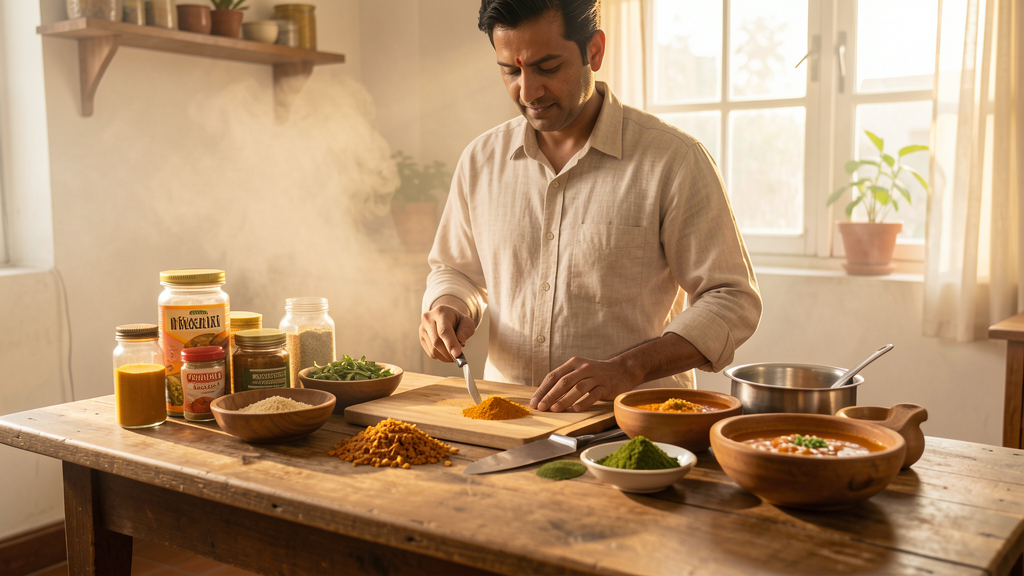
There is a specific kind of frustration that arises when you try to slice a slippery, quartered drumstick (moringa) or trim a cluster of tender okra with a heavy, 10-inch Western chef’s knife. The blade is too long, the heel digs into your cutting board, and the balance is entirely wrong for the quick, precise movements required for subzi (vegetable) prep. Most home cooks in 2026 are still convinced that the all-purpose chef’s knife is the only tool they need, yet they wonder why chopping a kilo of potatoes for Aloo Gobi feels like a workout and results in uneven, dangerously ragged chunks.
The problem isn't your knife skills; it's the geometry. Indian cooking relies heavily on a high volume of fresh vegetables that require varied techniques—smashing aromatics, julienning root vegetables, and peeling thin-skinned gourds. A large rocker-style knife forces you to "saw" through ingredients rather than executing clean, vertical cuts. This changes the texture of your vegetables. When pieces are uneven, they release moisture at different rates, wreaking havoc on the consistency of your curry base. If you have ever added your water or coconut milk only to see the oil separate and the gravy turn grainy, it is often because your ingredients were jagged and torn, unable to cook down into a uniform paste.
By swapping the "one size fits all" philosophy for specific blade shapes, you stop fighting the food and start processing it efficiently.
The Nakiri: The Geometry of the Flat Chop
The first and most critical swap you can make is replacing your bulky chef's knife for vegetable prep with a Japanese Nakiri. This is a double-beveled vegetable cleaver with a completely flat spine and a squared-off tip. Unlike a chef's knife which curves up to a point, the Nakiri lies perfectly flat against the cutting board from heel to toe.
Why does this matter for Indian cuisine? Consider the act of chopping four large onions for a gravy base. With a curved knife, you have to rock the blade or use a see-saw motion, which often leaves the root end uncut and requires a second pass. The Nakiri allows for a full-length push cut or a vertical chop that severs the onion completely in a single motion. The straight blade also acts as a bench scraper; you can use the flat side to scoop up your chopped onions and transfer them directly to the hot pan without dirtying a separate tool.
It is equally superior for delicate vegetables like bhindi (okra) or broad beans (chawli). When you slice okra with a curved blade, the vegetable often rolls away, and the tip of the knife misses the mark, requiring you to chase the pod across the board. The Nakiri’s tall blade provides a stable backstop, keeping the vegetable in place while your knuckles guide the flat spine down. This yields uniform discs that cook evenly, ensuring they fry rather than steam—a crucial distinction for avoiding the dreaded sliminess.
The High-Carbon Paring Knife: For Rustic, Textured Masalas
While the Nakiri handles the volume, you need a smaller, agile blade for the intricate work of peeling and trimming ginger, garlic, and green chilies. Here, I recommend a simple, high-carbon steel paring knife. Avoid the expensive, stamped stainless steel varieties; you want a blade that takes a screaming edge and feels slightly "toothy" on the vegetable.
Many home cooks reach for a microplane to grate ginger. While this extracts juice quickly, it turns the ginger into a pulp that disappears into the curry. Using a small paring knife to mince ginger into tiny, distinct cubes offers a different sensory experience. When you bite into a spoonful of Dal Tadka, hitting a tiny cube of pungent, sautéed ginger provides a burst of heat that a pureed paste cannot deliver. The paring knife gives you control over this texture. Use the tip of the blade to scrape away the thin skin of the ginger without wasting the flesh underneath—something that is nearly impossible to do efficiently with a large blade.
This tool is also essential for scoring vegetables. Before frying eggplant for Baingan Bharta, shallow scores in the skin allow the oil and smoke to penetrate the flesh. A paring knife lets you make these incisions with surgical precision without cutting all the way through and tearing the vegetable apart.
The Flexible Boning Knife: Peeling Gourds Without Waste
One of the most common errors in Western-style Indian prep is using a stiff chef's knife to peel tough-skinned gourds like bottle gourd (Lauki), ridge gourd (Turai), or pumpkin (Kaddu). The rigid blade follows the natural contours of the vegetable poorly, resulting in you hacking away half the edible flesh along with the skin.
A flexible boning knife, typically reserved for fish or meat in French kitchens, is the secret weapon here. The thin, flexible blade allows you to bend the steel to match the exact curvature of the gourd. You can keep the pressure light and the cut shallow, preserving as much of the vegetable as possible. The narrow blade also makes it incredibly easy to navigate the ridges of a ridge gourd, scraping off the rugged bumps without needing to apply heavy downward pressure.
When making a sweet and sour Kaddu (pumpkin) curry, the texture of the pumpkin is paramount. You want the cubes to hold their shape while melting in the mouth. Using a boning knife to peel cleanly ensures the skin is removed uniformly, so the heat penetrates the flesh evenly. If the peel is patchy, some parts of the cube will turn to mush while others remain crunchy, disrupting the harmony of the dish.
The Heavy Chinese Cleaver: Processing Tamarind and Hard Roots
There is a misconception that cleavers are only for butchers. In the context of Indian spices and prep, a heavy Chinese cleaver (Cai Dao) is a multitasking powerhouse, particularly for ingredients that require brute force or blunt impact.
Consider a block of dried tamarind. Trying to chop this with a standard knife is dangerous; the blade often slips, glancing off the hard, sticky surface. The weight of a heavy cleaver does the work for you. You can place the heel of the cleaver on the block and strike the spine with your palm to break it into chunks for soaking. This technique is safer and faster than sawing away with a lightweight blade.
Furthermore, the spine of the cleaver is a built-in tenderizer and crusher. When preparing a marinade for Khatta Meat, you often need to crush green cardamom pods, cloves, or lemongrass stalks to release their oils. You can use the blunt spine of the cleaver to smash these aromatics against the board. The wide surface area also acts as a perfect scoop for transferring chopped ingredients from the board to a heavy-bottomed pot or pressure cooker, reducing the number of trips back and forth.
The Petty Knife: Precision for Aromatics and Garnishes
Sitting between the small paring knife and the large chef's knife is the "Petty" knife, usually around 120mm to 150mm. This is the utility player for your practical prep routine, specifically designed for the medium-sized tasks that feel awkward with the other tools.
The Petty knife shines when dealing with garnishes and aromatic garnishes that define the finish of a dish. If you are making Chicken 65 or a Kurma that calls for a fine julienne of fresh ginger and green chilies to be added at the very end, the Petty knife offers the length of a chef's knife with the agility of a parer. It allows you to make long, consistent cuts without the blade feeling unwieldy.
It is also the ideal tool for deveining shrimp or cleaning smaller cuts of meat. When preparing Chemmeen Mappas (Prawn Curry), you need to slit the shrimp backs without cutting them completely in half. The sharp point and moderate length of the Petty knife give you the control to trace the vein perfectly. A chef's knife is too clumsy for this work, often crushing the delicate shell or cutting too deep.
Consistency Is Visual and Tactile
Equipping your kitchen with these five blades changes the physical act of cooking, but the payoff is in the pot. When your vegetables are cut with precision, the heat distribution is consistent. This is vital for the emulsification of your masala. As you sauté your onions, tomatoes, and spices, watch for the consistency of the base. You are looking for the mixture to thicken until it leaves a glossy sheen of oil on the sides of the pan. The droplets should be clear and separate from the paste; this indicates that the moisture has evaporated and the proteins have caramelized.
If you add your second liquid—whether it is water, coconut milk, or yoghurt—before this visual cue appears, the high water content in your jagged, uneven vegetables will shock the sauce, causing the fats to separate and the gravy to split. Conversely, if you wait too long, the sugar in the onions and tomatoes can burn. The right knife ensures your vegetables are uniform, which means they predictably release their moisture at the same rate, giving you a wider, safer window to hit that perfect consistency.
Ultimately, the right tool doesn't just make the work faster; it makes the food taste better by preserving the integrity of the ingredients from the cutting board to the curry pot.