Editorial image illustrating Rajma vs. Chole: The Skin Porosity Factor for Faster Spice Absorption
I see this complaint constantly in our inbox: "I simmered my beans for four hours, yet they taste like nothing but salty mush." The frustration is palpable, but the mistake is almost never the spice blend. It is a misunderstanding of the vessel you are trying to flavor. In 2026, with air fryers and instant pots dominating our counters, we have largely forgotten the biology of the ingredients we cook. We treat all pulses as identical sponges, assuming they will greedily soak up whatever turmeric and coriander we throw at them.
This could not be further from the truth. When preparing dry curries—dishes where the bean is the star and the gravy is merely a clinging coating rather than a drowning soup—the porosity of the bean’s skin is the single most critical variable. If you do not account for the density of the testa, that outer skin layer, you will end up with a bland core and a dusty exterior.
We are looking at the heavyweight contenders of North Indian comfort food: Red Kidney Beans (Rajma) and Chickpeas (Chole). One of these absorbs spices significantly faster than the other, and if you are short on time, your choice of legume dictates your success rate.
The Anatomy of the Cuticle: Why Your Spices Slide Off
To understand absorption, we have to look at the surface topography. Kidney beans, specifically the Phaseolus vulgaris varieties common in North India, possess a remarkably smooth, tight cuticle. That glossy sheen you see on a dried red kidney bean? It acts as a raincoat. It is hydrophobic by design, evolved to keep the seed viable in dry conditions.
Contrast this with the chickpea (Cicer arietinum). Run your finger over a dried garbanzo bean, and you will feel a rougher, slightly pitted surface. Under a microscope, the chickpea skin is more fibrous and less dense than the kidney bean's waxy coat. This structural difference means that chickpeas are mechanically more likely to trap microscopic particles of spice powder in their imperfections, while kidney beans require a chemical breakdown of that waxy layer to permit entry.
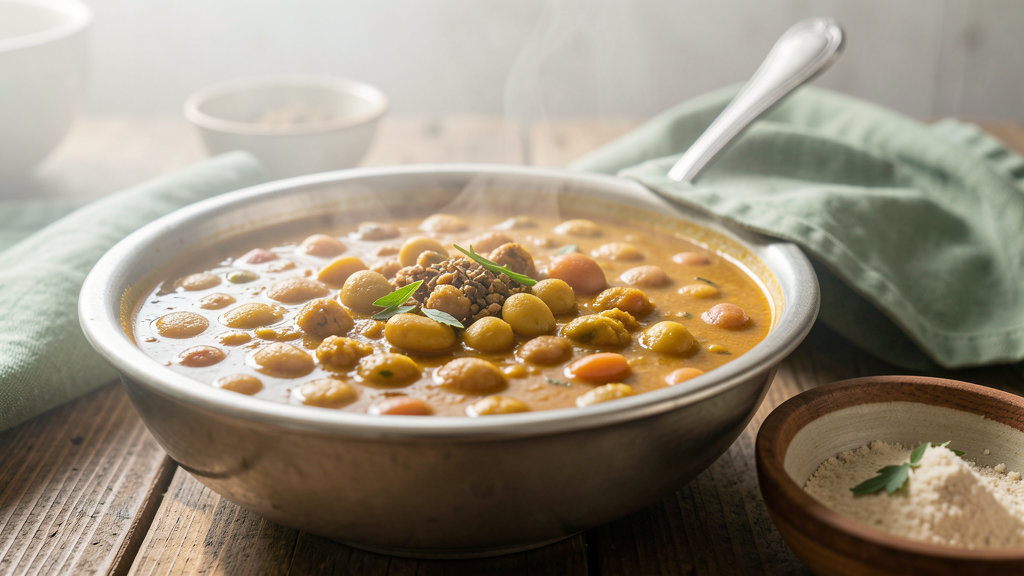
This is why a simple bhunao technique often fails for Rajma if applied like you would to Chole. You are essentially trying to paint gloss enamel with watercolor. The spices slide right off the surface and burn at the bottom of the pot.
The Starch Interference: A Hidden Barrier
It is not just the skin fighting you; it is the interior. Kidney beans are high-amylose starch bombs. When they cook, they release a thick, creamy slime. This is desirable for a saucy Rajma Masala, but it is a disaster for a dry preparation like a stir-fry or a Sukha dish. That released starch coats the exterior of the bean, effectively sealing the skin even further.
Chickpeas, while starchy, hold their structure more rigidly. They do not burst as readily as kidney beans, meaning they release less surface starch during the initial cooking phase. A cooked chickpea, even when boiled perfectly, remains relatively dry on its surface compared to the slimy coat of a boiled kidney bean. For spice absorption, "dry" is good. It creates friction. It allows the masala to grip.
If you are making a dry curry, you must wash your boiled kidney beans aggressively—perhaps even shock them in cold water to stop the starch release—whereas chickpeas can often go straight from the boiling water into the tempering pot with just a quick drain.
The Permeability Test: Raw vs. Cooked States
I conducted a small experiment in the test kitchen just last week using raw, store-bought turmeric and Kashmiri chili powder to visualize absorption rates. I took two batches, one of Rajma and one of Kabuli Chana, soaked them for the standard 8 hours, and then coated them in the spices without any heat or oil.
The chickpeas began to stain the surface of their skins within fifteen minutes. The red pigment settled into the tiny crevices. The kidney beans? After an hour, the turmeric could be wiped off with a damp paper towel, leaving the skin largely untouched. The waxy barrier on the kidney bean was preventing osmosis.
Heat and fat are the great equalizers here, but the initial resistance means kidney beans require a longer exposure to hot fat to soften that cuticle. You cannot rush Rajma. You have to coax the skin to open up.
The Critical Window: When to Introduce the Liquid
Here is where most home cooks ruin the texture in a desperate bid to force flavor in. They add the liquid too early. Whether you are cooking Rajma or Chole, you must reach a specific sensory consistency in your onion-tomato base before the legumes touch the liquid. This is the "Masala Gloss" stage.
You are looking for the oil to separate completely from the paste. The mixture should not just bubble; it should ooze. If you tilt the pan, the base should hold its shape for a second before sliding slowly, resembling a thick volcanic mud rather than a watery slurry. The aroma must shift from raw garlic to a nutty, caramelized sweetness that hits the back of the throat. If you add water or stock while the tomatoes still smell acidic, the beans will boil in acid and salt, hardening their skins against the fat.
This rule applies to both, but the consequences are more severe for Rajma. If Chole is added to a slightly under-cooked base, the rough skin will still catch some flavor. If Rajma is added early, the high water content of the under-cooked base combined with the bean's starch creates a barrier that no amount of later simmering can fix.
Time, Pressure, and the "Mush" Factor
Assuming we are aiming for a dry curry where the bean retains its shape, we must consider the cooking method. In a stovetop pressure cooker, kidney beans turn to mush if they are cooked to the point of flavor permeability. To get the spices inside a kidney bean, you usually have to overcook it.
Chickpeas are more forgiving. They possess a denser cellular structure that withstands high pressure and long simmering without disintegrating. You can cook Chole until the spices have fully penetrated the interior—about 4 to 5 whistles on a standard pressure cooker—and they will still pop when you bite them. Try that with kidney beans, and you will be serving a dal, not a bean dish.
This structural integrity is why Chole is the superior candidate for a "quick" dry curry. You can pressure cook them, drain them, and toss them in a high-heat tadka (tempering), and they will absorb the oil and spices within ten minutes. Rajma needs a gentle simmer after the pressure cook to let the spices marry, often requiring an additional 20 to 30 minutes of open-pot cooking to reduce the external starch and tighten the skin again.
The Verdict: Choosing Based on Your Schedule
So, which bean absorbs spices faster? The answer is definitively the Chickpea (Chole). Its rougher skin topography, lower surface starch release, and higher structural integrity allow it to grab onto fats and ground spices immediately upon contact.
Kidney beans (Rajma) are the slow absorbers of the legume world. They are the heavy coats of winter; they take longer to break in, but they offer a depth of creaminess that chickpeas cannot match. If you have 45 minutes to make dinner, reach for the chickpeas. If you want to spend a Sunday afternoon tending to a pot, slowly reducing the liquids until the beans are wrinkled and deeply stained, make the Rajma.
Do not fight the biology of the bean. If you choose Rajma for a quick weeknight stir-fry, you must adjust your technique. I recommend taking a ladle of the boiled beans and mashing them into a thick paste before adding them back to the pot. This paste acts as a vehicle for the spices, coating the whole beans and forcing the flavor into them since the skin refuses to let it in.
For Chole, simply drain them well. You want that surface friction. You want the skin to catch the jagged edges of the coriander seeds and the heat of the green chilies. Trust the texture of the chickpea to do the work for you. It is why, in the debate of speed and spice absorption, the humble chana wins every time.
For those struggling with the basics of legume preparation, remember that the soak is just as important as the cook. If you find your beans taking forever to soften, check your water quality and soaking duration. Refer to our guide on Why Soak Toor Dal? The Texture Difference Explained to understand how hydration alters the cellular wall of similar pulses.
And if you are unsure whether your beans are ready to meet the spices, look beyond the softness. Watch the skin. A bean is truly ready for the masala only when the skin has lost its wrinkle and looks tight against the flesh, signaling that the internal pressure is high enough to accept new flavors. If you miss this sign, you will end up with the dreaded "hard center, mushy outside" phenomenon, which is often a sign of under-soaking rather than under-cooking. We cover these subtle indicators in our list of 4 Signs Your Chana Dal Is Undercooked (That Aren't Hardness).