Dal & Legumes
The Salt Myth: Why Waiting to Season Your Dal Is a Mistake
Stop fearing the salt shaker; seasoning your lentils early unlocks deep flavor penetration and a creamier texture without extending cooking times.
7 min read
 Practical guides to practical Indian cooking, spices and weekly curries
Stop relying on the bite test; learn to spot raw starch, lack of absorption, and gritty textures that ruin chana dal despite a soft exterior.
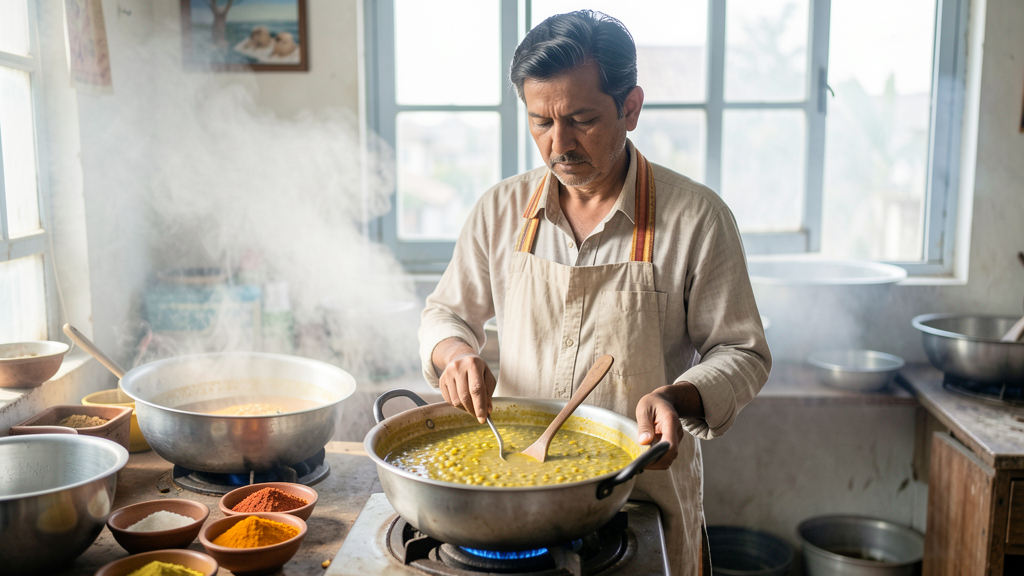
Editorial image illustrating Beyond the Crunch: 4 Subtle Signs Your Chana Dal Is Undercooked
We have all been there. You stand over the stove, spoon in hand, fishing out a single grain of chana dal. You press it against the roof of your mouth. It yields. It feels soft. You assume the work is done. You temper your spices, pour in the ghee, and serve the dish to your family or guests. An hour later, the kitchen is quiet, but the stomachs are not. The heavy, bloated sensation sets in, and you realize the betrayal: the dal was raw.
The tragedy of chana dal—split chickpeas—is that they are masters of disguise. Unlike whole chickpeas or kidney beans, which remain rock-hard bullets until they surrender, split pulses have a vulnerable outer skin that hydrates and bursts quickly. This gives the illusion of doneness while the dense, starchy center remains a raw, cement-like core. Relying solely on the absence of hardness is a rookie mistake that ruins countless curries.
To achieve that buttery, melt-in-the-mouth texture characteristic of a well-executed dal-legumes dish, you must look deeper than the structural integrity of the grain. You have to analyze the chemistry of what is happening in the pot.
Here are the four specific signs your chana dal is undercooked, signs that have nothing to do with whether the grain is hard or not.
The most insidious indicator of undercooked chana dal is not a texture, but a flavor profile that should not exist in a finished curry. If your dal tastes "dusty," "earthy" in a bad way, or reminiscent of raw wheat flour, the starch granules inside the pulse have not gelatinized.
Properly cooked chana dal should taste nutty, slightly sweet, and deeply savory, carrying the aromatics of the tempering. When undercooked, the interior retains the starchy flavor of the raw pulse. This taste is difficult to mask with spices; in fact, heavy spicing often exacerbates the problem by creating a flavor clash between the complex masala and the raw, paste-like center of the bean.
Consider the difference between eating raw pasta dough versus al dente pasta. That raw, pasty flour taste is what you are detecting here. It sits on the back of the tongue and refuses to integrate with the tartness of tomatoes or the heat of chilies. This happens because the heat penetrated enough to soften the cell structure but not enough to break down the starch chains completely. You might think adding more salt will fix it, but seasoning cannot correct undercooked carbohydrates. In fact, many home cooks hesitate to add salt early due to the pervasive myth that adding salt makes lentils cook slower, which often results in undersalted, undercooked pulses that lack structural integrity.
If you taste a raw flour note, the dish is not finished. Return it to a simmer, add a splash of hot water, and cover it. The goal is to convert that starch from a resistant state into a digestible, creamy consistency.
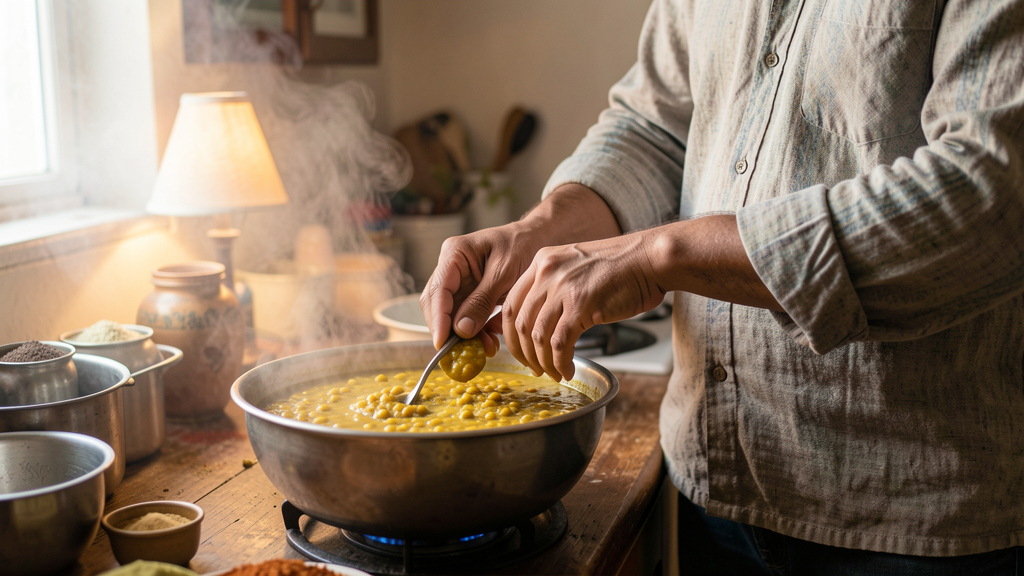
Hardness is obvious; grittiness is subtle. When a dal is truly cooked, it should offer a creamy, yielding mouthfeel. Undercooked chana dal, however, often presents a fine, sandpaper-like resistance. It is not the crunch of an unsoaked bean. It is a micro-grit that coats the teeth and tongue.
This sensation occurs because the interior of the split chickpea has not fully broken down into a smooth mash. Instead of dissolving, the flesh separates into minuscule, fibrous particles. When you chew, these particles rub against each other and your dental enamel. Think of the difference between smooth mashed potatoes and those that have been roughly crushed with a skins-on approach—it is that textural friction that signals the problem.
To test for this, do not just swallow the grain immediately. Chew it ten or twelve times. If you feel a sandy residue accumulating, the dal needs more time. This grittiness is also a major culprit for the indigestion many associate with heavy dal consumption. The stomach struggles to break down these particulate matters, leading to gas and bloating.
I often see this mistake in recipes that claim a "quick" chana dal can be made in twenty minutes without soaking. While high pressure can soften the skin, the fibrous interior requires time to hydrate and collapse. Skipping the hydration phase—something we emphasize when discussing why soak toor dal for texture difference—almost guarantees this gritty outcome.
Visual cues are just as critical as taste and texture. Examine the individual grains in your serving bowl. A fully cooked chana dal should look swollen, with the skin stretched tight or slightly peeled back, revealing a translucent, yellowish interior. If the grains look small, dense, and opaque, they are holding onto their structure rather than welcoming the liquid.
This sign is most evident when you compare the volume of dried dal you started with to the finished product. A 1-cup measure of dried chana dal should more than double in volume once properly cooked. If your volume hasn't increased significantly, the water hasn't penetrated the core. The grains might be soft because they are steamed, but they are dry inside.
Another visual red flag is the lack of cloudiness in the cooking liquid (before you add your aromatics). While we want a clear soup for some dals, chana dal releases a significant amount of starch into the water as it cooks. If the water remains relatively clear while the grains look intact, the starch is still trapped inside the bean.
This phenomenon mirrors the absorption rates seen in heavier pulses. As we note in the comparison of Rajma vs. Chole: Which Bean Absorbs Spices Faster, the density of the seed dictates the hydration timeline. Chana dal is deceptively dense. If the water level in your pot hasn't dropped noticeably or the grains haven't plumped up, the cooking process is incomplete.
The final sign is technical and relates to the physics of your sauce. This is where my years in the test kitchen come into play. The consistency of the curry base must be described in sensory detail so the reader knows exactly when to add the liquid to prevent splitting. A perfectly cooked chana dal releases enough amylose starch to thicken the surrounding water into a cohesive, velvety sauce that clings to the back of a spoon.
If your chana dal is undercooked, the sauce will look "broken" or weak. You will see a watery broth with distinct, pebble-like grains floating separately. The liquid will not have that slightly glossy, sheen-like quality that comes from fully gelatinized starch. Instead of a unified curry, you have a soup with things in it.
This lack of emulsification makes it impossible for the spices to bind to the dal. The oil from your tempering will float on top in distinct droplets rather than dispersing into a homogeneous layer. When you try to mix it, the oil and water separate instantly. This is a visual and textural failure.
To fix this, you must cook the dal further, uncovered if necessary, to reduce the liquid and force the starch out. You are essentially making a starch slurry inside the pot. Mash a few grains against the side of the pot to help this process along. You are looking for the sauce to coat the grains, almost glazing them, rather than just surrounding them.
The Smush Test is the Only Truth
Ultimately, sensory clues are guidelines, but there is one mechanical test that never lies. Forget the bite. The "Smush Test" is the gold standard for chana dal in 2026. Take a single grain between your thumb and index finger. Apply gentle, rolling pressure.
A cooked grain should offer zero resistance. It should disintegrate into a smooth paste instantly, feeling like soft butter or toothpaste. If you feel a tiny "pop" or a BB-like pellet inside the mash, or if the paste feels grainy or fibrous, it is not done. Do not serve it. Your guests' stomachs will thank you for the extra ten minutes of simmering.

Stop fearing the salt shaker; seasoning your lentils early unlocks deep flavor penetration and a creamier texture without extending cooking times.
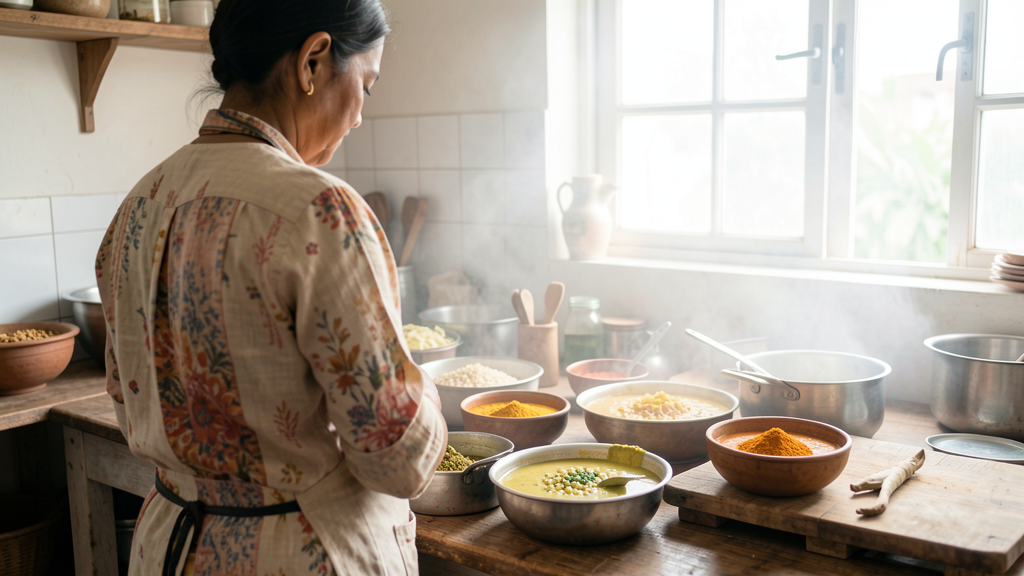
Soaking toor dal is not merely a time-saving hack; it is a critical chemical step that breaks down phytic acid to ensure a velvety, creamy consistency rather than a gritty one.