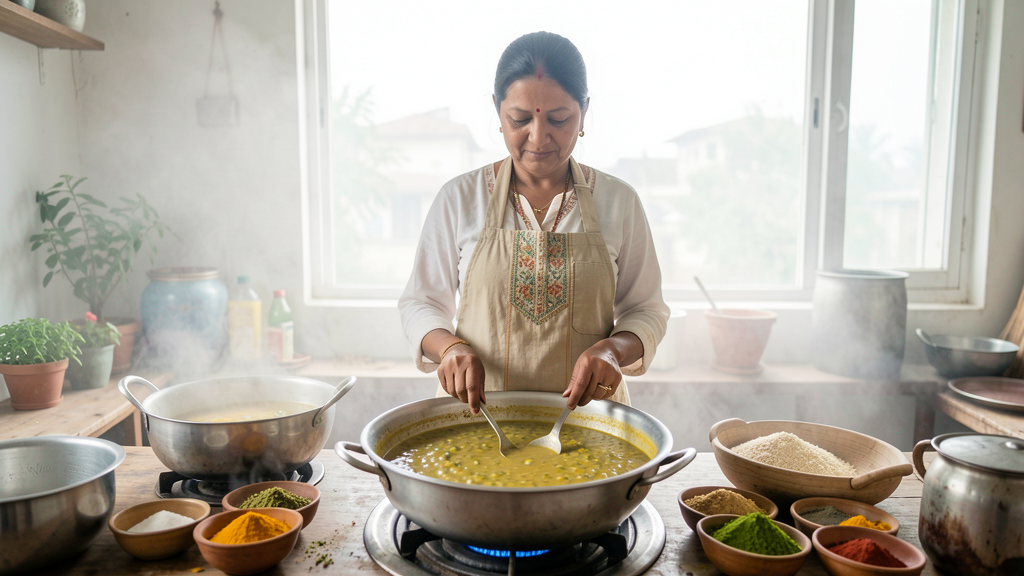
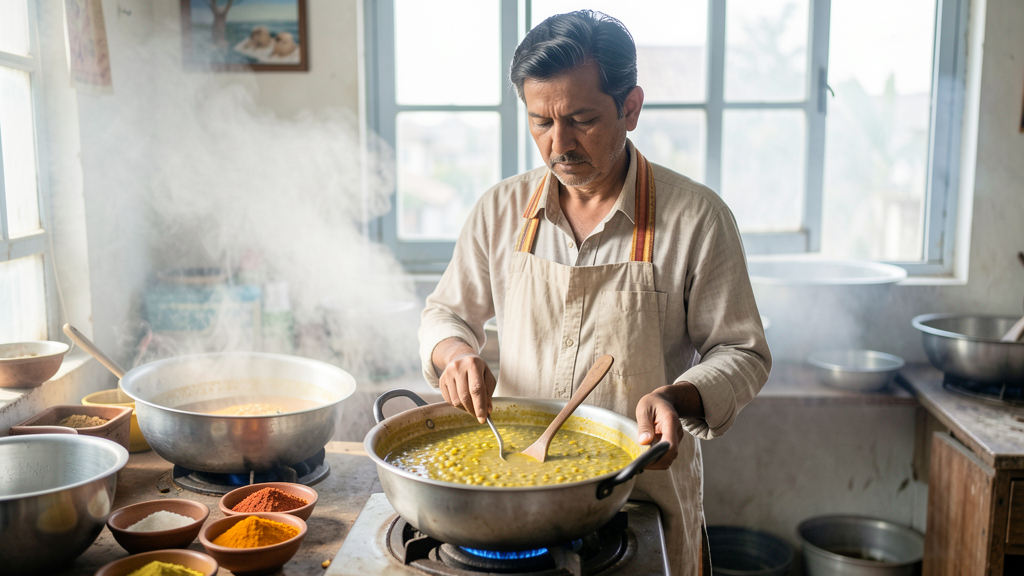
Editorial image illustrating The Salt Myth: Why Waiting to Season Your Dal Is a Mistake
I remember standing at the stove in my Mumbai apartment, my grandmother hovering over my shoulder, swatting my hand away from the salt jar. "Not yet," she would insist, her voice dropping to a conspiratorial whisper. "The skin will get tough. They will never soften." For years, I adhered to this dictum, simmering pots of unseasoned lentils, tasting bland, insipid broths that I had to correct aggressively with tadka and finishing salt at the very end. The result was often a two-toned dish: a salty, spicy exterior surrounding a dull, flavorless interior.
In the test kitchen at Massalaapp, we decided to put this generational fear to the test. We cooked batch after batch of toor dal, chana dal, and masoor dal, salting at different stages—some at the start, some when the water began to simmer, and others only after the lentils had fully collapsed. The results were conclusive, and they completely contradict the old wives' tale that still dominates Indian home cooking. The fear that salt hinders hydration is largely a relic of cooking with aged, dried beans in open pots over low heat for hours, not the reality of how we prepare dal and legumes in 2026.
The Osmosis Fallacy That Ruins Flavor
The scientific basis for the myth is sound in theory but weak in practice for lentils. The logic is that salt creates a hypertonic environment, drawing water out of the plant cells via osmosis, thereby preventing the starches from gelatinizing and the proteins from breaking down. While this happens with dense, dried kidney beans that have been sitting on a shelf for three years, it simply does not apply to most split lentils used in daily Indian cooking.
When we salted our Toor dal at the very beginning of the boil, the cooking time did not increase. In fact, the lentils broke down more uniformly. When you hold back on salt, you miss the critical window for osmosis to work in your favor. Salt is an ion that helps penetrate the pectin and hemicellulose in the lentil seed coat. If you add it at the end, you are essentially painting the outside of the lentil with salt. The interior remains bland because the sodium ions haven't had time to migrate through the cell structure during the heating process.
We ran a blind taste test last Tuesday with three team members. The unseasoned dal, salted only after pureeing, tasted "flat" and "wet," despite having the same salinity as the batch salted at the start. The early-seasoned batch tasted "deep" and "integrated," described by one taster as tasting like the dal itself was the source of the flavor, rather than a vehicle for salt water.
The Role of Agitation Over Salinity
There is a kernel of truth to the myth, but it has been misidentified for decades. Salt does not make lentils tough; high heat and violent boiling do. If you salt your lentils and then blast them on a high rolling boil, the skins will indeed toughen and eventually split apart from the rapid expansion of the starch inside. Many cooks mistake this splitting and toughening for the "salt effect," but it is actually thermal shock.
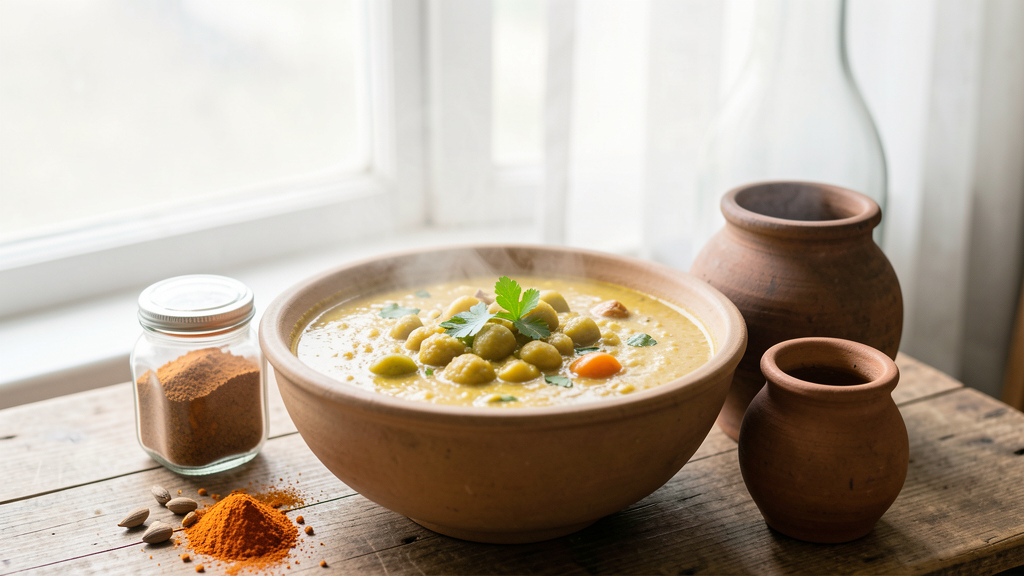
The key is to maintain a gentle simmer. We found that 1 teaspoon of fine sea salt added to 1 cup of toor dal at the start of a gentle simmer resulted in perfectly tender grains in 18 minutes. The skins remained intact but yielded easily to the tongue. Conversely, an unsalted batch boiled furiously took 25 minutes and still had a chalky, resistant texture.
If you are worried about the skin, check your boil, not your salt. The surface of the water should tremble with small bubbles that lazily break the surface. You want a steady, rhythmic simmer, not a chaotic geyser. This is especially true for Chana dal, which has a thicker skin and requires more patience. The misconception arises because we often associate salting with the start of the cooking process, which is also when we are often rushing to bring the pot to a boil. We blame the salt, but it is actually our impatience that is ruining the texture.
Why Brining Lentils Actually Helps
Instead of thinking of salt as a barrier to hydration, we should view it as a flavor enhancer that modifies the protein structure, making it more receptive to moisture. Think of it as a mini-brine. Brining meat is standard practice because the salt denatures proteins, allowing them to hold more juice. The same principle applies to the legumes. By salting early, you are gently teasing apart the protein matrix in the lentil, allowing water to enter more efficiently, not less.
This structural change is evident in the final "mash." When making a classic Dal Tadka, we want the lentils to emulsify into a thick, creamy consistency. Lentils salted at the beginning break down into a velvety puree with far less mashing. The starch releases into the cooking liquid, thickening it naturally without the need for heavy cream or excessive reducing. This is the secret to restaurant-style dal that feels substantial rather than watery.
If you are still skeptical, consider the specific variety of lentil. The myth fails most spectacularly with red lentils (masoor dal). These split lentils are so thin they cook in a flash. If you wait until they are done to add salt, the water has already been absorbed or evaporated. You end up having to add more water to dissolve the salt, which dilutes the flavor. Salt your masoor dal as soon as the water hits the pot, and you will find the flavor is vibrant throughout every spoonful.
The Visual Cues of a Perfectly Salted Dal
So, how do you know if you have achieved the balance? The visual cues are subtle but telling. As the lentils cook, the water should turn slightly cloudy as the starch leaches out. If you salted correctly, this cloudy broth will look homogenous. If you did not salt enough, the broth looks clear and separate from the lentils, like oil and water that haven't emulsified.
When the lentils are tender, the consistency of the curry base before you add the tempering is crucial. It should coat the back of a wooden spoon. If you run your finger through the coating on the spoon, the trail should remain distinct and clean. This viscosity indicates that the starch has been fully extracted and hydrated, a process that salt facilitates.
For those working with tougher beans like Rajma or Chole, the strategy shifts slightly, but the principle remains. I recommend checking out the breakdown on Rajma vs. Chole; the absorption rates differ, but the window for seasoning is still early in the boil, not at the end. With these larger legumes, I suggest salting the soaking water the night before. This is the ultimate test. Beans soaked in a 3% salt solution cook faster and more evenly than those soaked in plain water, definitively proving that salt is an ally, not an enemy, of tenderness.
The Verdict for Your Kitchen Tonight
Stop hovering. Stop waiting. The next time you rinse your Toor dal, toss it into the pot, add your water, turmeric, and salt immediately. Bring it to a gentle simmer. Taste the broth halfway through; it should taste slightly saltier than you want the final dish to be, as the lentils will absorb some of that salinity. You will find that the final product requires less finishing salt, tastes more complex, and has a texture that is undeniably superior.
The myth of the "salt toughener" survives because it is a convenient rule of thumb for cooks who don't want to pay attention to the heat. It is easier to say "never add salt" than to explain "maintain a gentle simmer and watch the skin integrity." But precision is what separates a good dal from a great one. Embrace the salt early, and you will transform a humble pot of legumes into a dish with depth, character, and a texture that truly sings.