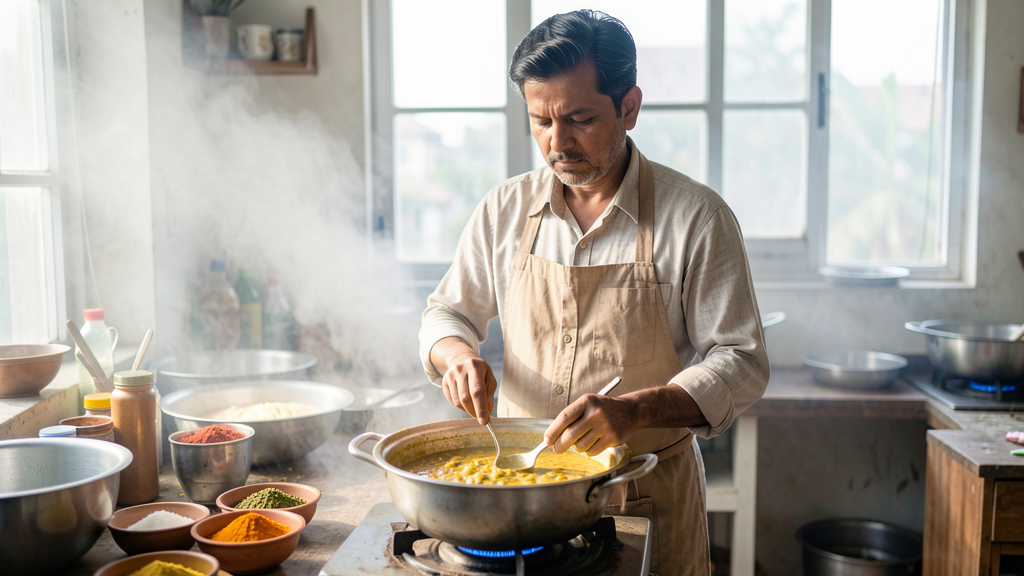
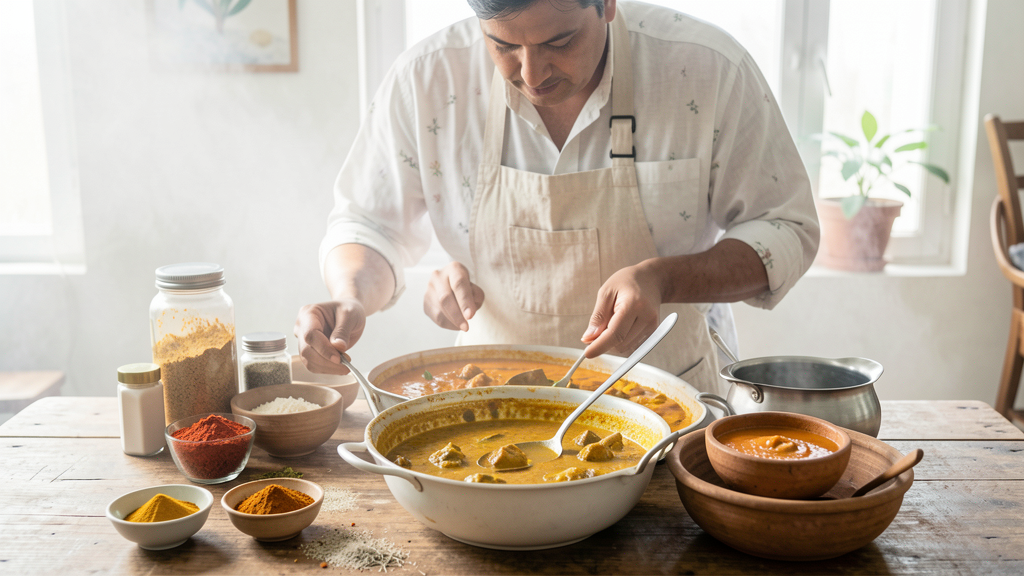
Editorial image illustrating The Sunday I Made 2 Liters of Onion Masala and Saved My Week
Until April of this year, my relationship with weeknight dinners was defined by a specific kind of exhaustion. It wasn’t the physical labor of standing at the stove that got to me, though chopping vegetables is rarely anyone's idea of leisure after a ten-hour workday. It was the mental load. The decision fatigue. Every evening at 6:30 PM, I would stand in front of the refrigerator, knowing full well what I needed to cook—a simple Rajma, perhaps, or a Chicken Kurma—but dreading the inevitable forty-five minutes of prep work before the rice could even hit the boil.
The bottleneck was always the onions.
In Indian cooking, the base is everything. You cannot simply sauté a diced onion and throw in spices; the foundation requires a patience that the clock rarely affords on a Tuesday. You need that slow reduction, the caramelization, the transformation of pungent, raw sulfur into sweet, dark, sticky unctuousness. Doing this from scratch every single night is a luxury of time I no longer possessed.
So, last Sunday, I decided to change the logistics of my kitchen. I woke up with a singular goal: to front-load the labor. I wasn't just making dinner; I was operating a small factory. The objective was to produce 2 liters of Onion Masala—essentially a concentrated, pre-cooked flavor base that would turn weeknight cooking into an assembly task.
The Breaking Point: Why 7 PM Tears Were No Longer Romantic
I love cooking. I love the alchemy of it. But there is a distinct difference between the creative act of cooking and the mechanical act of production. For weeks, I had been skipping complex curries in favor of stir-fries or eggs, simply because I couldn't face the onion-tears and the oil-splatter involved in starting a gravy from zero.
I analyzed my friction points. Chopping took 10 minutes. Frying the onions to the correct color took another 20 to 25 minutes of constant stirring to prevent burning. Only then could I add the ginger-garlic paste and tomatoes. That is nearly an hour of active work before the main protein or vegetable even enters the pan. By the time the curry was done, the kitchen was a disaster zone, and I was too tired to enjoy the meal.
I realized that if I could batch the first 80% of the process, I could reclaim my evenings. I wasn't looking for a shortcut that compromised taste. I was looking for efficiency. I headed to the market with a very specific shopping list. I needed 3 kilograms of red onions, 500 grams of tomatoes, and a fresh supply of whole spices.
Scaling Up: The Mathematics of 3 Kilograms of Onions
There is a psychological shift that happens when you buy three kilos of onions at once. It feels excessive. It looks excessive on the counter. But for a 2-liter yield of finished masala, this volume is necessary because onions reduce significantly in mass as they lose water.
I set up my station. I used the food processor for the first time in years—a tool I usually avoid because it can turn onions into a watery mush if you aren't careful. The key here is pulsing. You want a fine, even dice, not a puree. If the onions release too much water immediately in the pan, you end up steaming them rather than frying them, which inhibits the Maillard reaction. I processed the onions in batches, emptying them into a large bowl.
I also prepped my aromatics. I used my stash of homemade garlic-ginger paste, popping out four cubes (about 60 grams) to thaw. Tomatoes were blitzed into a smooth puree. Having everything measured and in bowls before the heat goes on is non-negotiable when working with this volume. Once you start cooking, you have two hands full of spatula and splatter guard; you don't have time to chop tomatoes.
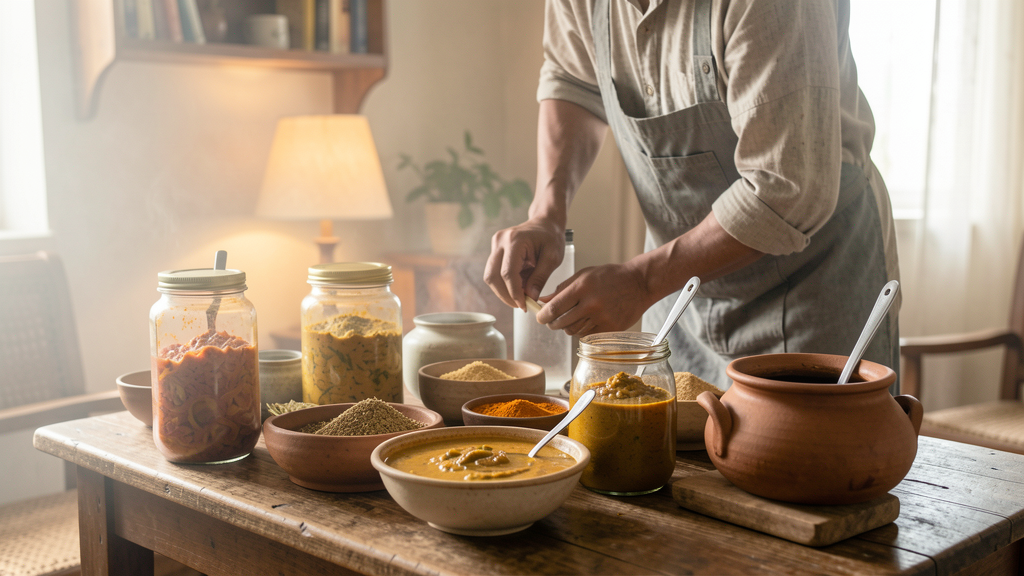
The Art of the Slow Bhunao: Getting to Deep Brown
The process of making this base is essentially one long, uninterrupted bhunao—the technique of cooking down a mixture until the oil separates.
I used my heaviest Dutch oven. A thin-bottomed pot will burn the onions before they cook through. I heated 1.5 cups of oil, which sounds like a lot, but remember: we are cooking for future meals here. The fat is a preservative as much as a cooking medium. Once the oil shimmered, in went the mountain of onions.
For the first fifteen minutes, the onions are raw and opaque. I kept the heat on medium-high, stirring constantly to ensure they didn't catch. The volume slowly began to collapse. Once they turned translucent and soft, I dropped the heat to medium-low. This is the waiting game.
I walked away from the stove for five minutes at a time, returning to scrape the bottom and incorporate the crusty bits forming there. The onions began to turn golden. This is the stage where most people stop for a quick dinner. I kept going. I wanted deep brown, almost chocolate-colored onions. This deep color provides the rich, caramelized backbone that defines a restaurant-quality curry.
Once the onions were a dark, sticky paste, I added the ginger and garlic. I cooked this for another ten minutes until the raw garlic smell vanished. In went the tomato puree. The mixture seized up slightly, turning a lighter color as the moisture from the tomatoes hit the hot oil. I cooked this until the oil began to separate again, glistening on the surface.
It was time to introduce the spices. I added 4 tablespoons of coriander powder, 2 tablespoons of Kashmiri chili powder (for color without excessive heat), and 1 tablespoon of turmeric. I toasted the spices in the hot paste for just two minutes.
Here is a crucial note on spice potency. Because I was making such a large batch, the spices need to be fresh. Old, faded spices will ruin months of effort. I buy my spices whole and grind them in small batches. I store my ground powders in airtight glass jars, kept strictly away from the stove's heat and direct sunlight. This simple discipline preserves the volatile essential oils for at least six months. If your spices smell like dust rather than vibrant aromatics, your masala will taste flat, regardless of how long you cooked the onions.
For more on the nuances of this stage, I revisited The Science of Browning Onions: Golden vs. Dark Brown Paste to ensure I wasn't over-reducing the sugars.
What I Left Out: Avoiding Freezer Failures
Before I turned off the heat, I tasted the base. It needed salt. I added 2 tablespoons of sea salt. This is important because the base is a concentrate; it should be slightly saltier than a finished dish.
I did not add garam masala. I did not add kasoor methi (dried fenugreek leaves). I certainly did not add cream or fresh cilantro. These ingredients have delicate volatile compounds or textures that do not survive freezing well. Cream can separate and curdle when reheated, and fresh herbs turn into slimy green mush.
There are specific pitfalls to freezing curry bases that can ruin the texture of your final dish. As I seasoned the pot, I kept in mind the advice on 3 Ingredients That Ruin a Frozen Curry Base. Keeping the "finishing" ingredients out ensures that when I defrost a bag in June, it tastes as vibrant as it did on this Sunday in April.
Portioning Strategy: How I Organized the Freezer
The masala had reduced to exactly 2 liters—a dark, aromatic brick of flavor. I let it cool completely. Putting hot food directly into the freezer raises the ambient temperature, which is unsafe for other groceries and causes condensation that leads to freezer burn.
I decided on a portion size of 250ml (about one cup). This is the perfect amount for a curry serving two people, or a very generous serving for one. I used high-quality freezer bags rather than rigid containers. Why? Because bags lay flat. This is a logistical game-changer. Once the bags are sealed and flat, they stack like papers. You can fit two liters of masala in a corner of a freezer drawer that would otherwise hold a single box of frozen peas.
I labeled each bag with the date and "Onion Base - S&P." I placed them in the freezer on a baking sheet to freeze flat before shuffling them into a organized stack.
The Payoff: A Week of 20-Minute Dinners
The real test came on Monday. I came home at 7:15 PM. Usually, this would mean a quick omelet or takeout. Instead, I grabbed a packet of frozen masala, thawed it in the microwave for three minutes, and dumped it into a small pan.
I added a cup of water and a can of chickpeas. While it simmered, I chopped some fresh cilantro and sprinkled in a pinch of garam masala. Fifteen minutes later, I was eating Chole Masala that tasted like it had simmered all day. The depth of flavor from the long-browned onions was undeniable. It was better than what I usually throw together on a Tuesday when I am rushing.
Tuesday was Paneer Butter Masala. Thursday was an Egg Curry. Each night, the active cooking time was strictly the time it took to cook the main protein and boil rice. The cleanup was minimal—one pot, one spoon.
There is a trade-off, of course. You need to block out three hours on a weekend, and you need a freezer with some spare space. Your kitchen will smell like onions for the better part of a Sunday. But the return on investment is exponential. By condensing the drudgery into one afternoon, I turned five nights of kitchen stress into five nights of relaxed assembly.
I haven't looked back. My evenings are longer, my stress levels are lower, and my curries are arguably better than ever because I have the patience to brown the onions properly when I am not starving at 7 PM. This logistical shift didn't just save me time; it saved my love for the process.
The Final Verdict on Batch Cooking
If you are serious about Curry Base Mastery, the freezer is your most powerful appliance. It allows you to decouple the long, slow cooking processes from the daily need to eat.
There is one nuance I learned the hard way: thickening agents. You might be tempted to add cashew paste or cream to the base before freezing to make it richer. Don't do it. I used to believe cream was necessary for a rich gravy, but I realized that you don't need cashews to thicken a rich gravy if your onion reduction is done correctly. A pureed, dark onion base provides incredible body without the heaviness of nuts or dairy.
This Sunday method has become a non-negotiable ritual in my house. It creates a surplus of time and flavor that pays dividends long after the stove is turned off.